
Dave Misra
Co-Founder and Managing Partner. Galaxy Data Centers | Data Center Strategist
Concerns over cost overruns and overprovisioning in the cloud are steering enterprises towards hybrid IT delivery models. Galaxy data centers are ready to host them.
Not so long ago, ‘cloud-first’ was the rallying cry in boardrooms, lured by the promise of agility, scalability and cost savings. When some of these promises were broken, attention turned to cloud repatriation, moving data, applications and workloads back into data centers, either as a private cloud or a new iteration of the old colocation model.
A best-of-both worlds hybrid strategy evolved, combining public clouds with ‘on-premise’ infrastructure and workloads running in data centers. Adoption is expected to double by 2026, according to a Frost & Sullivan report, with 66% of European firms agreeing that a hybrid model is necessary for a successful business; Gartner projects that 90% of organizations will adopt a hybrid cloud approach by 2027.
So what’s driving the change? Waste in resource provisioning and difficulty controlling costs around workloads are problems that have persisted in public clouds. Nearly half of IT decision-makers believe that more than a quarter of their cloud spend is wasted, with 31% saying that the waste exceeds 50% (VMware).
Making the business case for hybrid cloud
The business case for hybrid, however, is not just about cost. There are many good reasons to run and maintain a data center footprint:
Legacy workloads are not cloud-friendly: Older applications often rely on outdated architectures or hardware dependencies that don’t translate well to cloud environments. Rewriting or replatforming can be costly and risky compared to a data center tenancy.
Cloud storage isn’t practical for all data: Keeping sensitive or large volumes of data in a data center reduces cloud storage and egress costs, while maintaining control and compliance. Using secure, low-latency connections, data analytics work can still leverage cloud scalability and processing power.
AI and high-density computing are a bad fit for current cloud models: AI services and high-density computing demand low-latency interconnects, custom hardware, and predictable performance. Cloud environments often add network bottlenecks and higher computing costs, compared to more efficient local data center clusters.
Data sovereignty is becoming a bigger challenge: Stricter data residency laws require organizations to keep certain information within national borders. Hosting data in a fixed, controlled location ensures compliance and simplifies audits.

Advantages of cloud adjacent colocation
In Galaxy data centers, we give our clients assurances of fixed costs and predictable expenditure. Once you’ve invested in servers, rack space, power and cooling, there are no nasty surprises, no sudden spikes from unexpected usage or egress, or overconsumption of network bandwidth and overpriced storage.
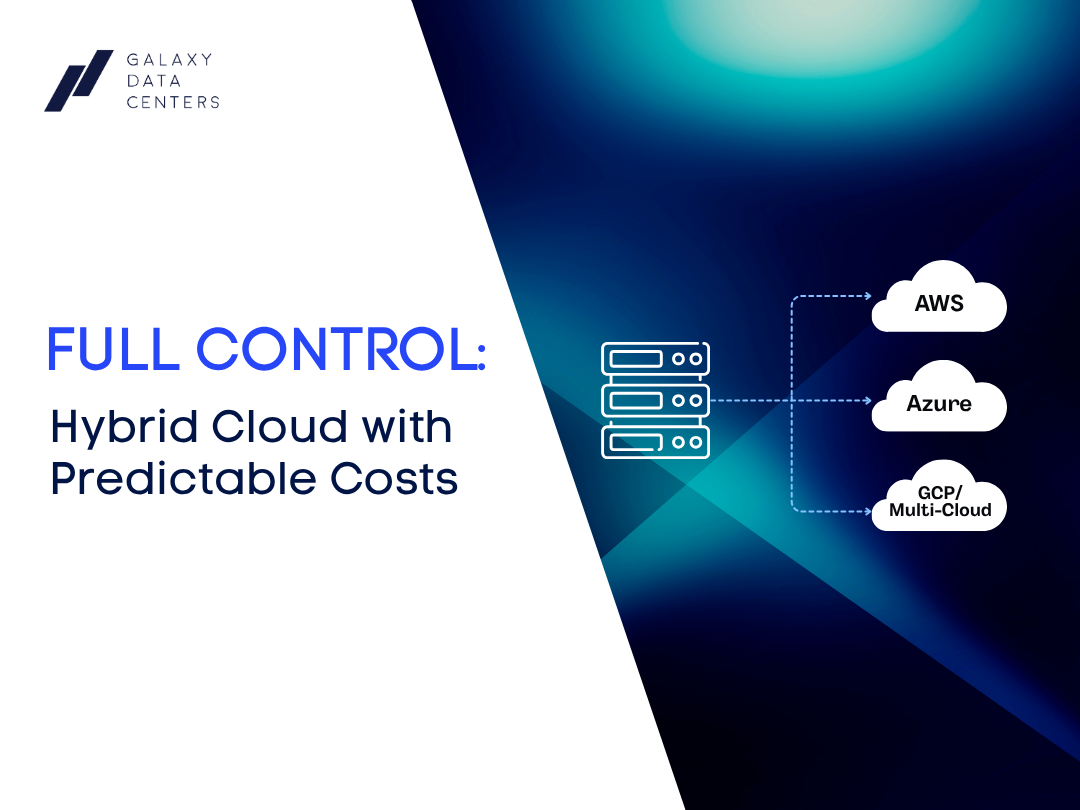
We offer cloud adjacent colocation, a hybrid model in the real sense, where you can access public cloud benefits while retaining full control over core data and infrastructure.
Our interconnected data centers provide fast access to public clouds with direct cloud on-ramps like AWS Direct Connect, Microsoft ExpressRoute and Google Cloud Interconnect.
As tenants, you control what’s running, where and when. If you have stable workloads, you can plan capacity and achieve high utilization, avoiding the many inefficiencies of public clouds, where idle virtual machines and overprovisioned services run up costs.
Future-proof fix for recurring cloud problems
Galaxy’s Redhill Data Center in Greater London reflects our company’s commitment to cloud adjacent colo that puts our tenants in control. The features and benefits provide a roadmap for developing a long-term hybrid strategy:
1. Optimize data placement for low latency and more efficient data workflows
Cloud adjacent colo brings data physically closer to users and clouds, cutting latency and boosting the speed of critical applications.
2. Take back control with predictable costs and performance
Consume only what’s needed and avoid always-on costs. Galaxy colo offers stable pricing and consistent performance without the hidden fees or throttling common in public clouds.
3. Rightsize applications/workloads to tailored private cloud environments
Run each workload in an optimized environment that combines the flexibility of cloud with the control of dedicated infrastructure.
4. Connect to any cloud partner or service while retaining data sovereignty
Cloud adjacent colo enables direct, secure interconnects to multiple clouds while ensuring your data stays within your chosen jurisdiction.
5. Allow both legacy applications and AI to flourish
Host traditional systems and cutting-edge AI racks side by side, with the power and cooling flexibility they both demand.
6. Combine dynamic scalability with cost controls and speed to value
Scale resources quickly as workloads grow without the unpredictable costs or delays of the public cloud.
7. Embed compliance, resilience and security into infrastructure and data workflows
Our enterprise-grade facilities are designed to ensure your operations meet regulatory, security and uptime requirements.
We understand that every business has unique challenges, whether it’s a complex and legacy-heavy IT estate at one extreme, or an innovative enterprise that want to steal a lead with AI-powered technology at the other. We can accommodate them all. Our commitment is to custom-built facilities designed to meet every need, from location selection to energy requirements and unique architectural designs. We will manage every detail to create an environment fully optimized for your operations.
📍 Schedule a Redhill site visit or a set up a meeting with Dave Misra today.