Ash Gupta
Co-Founder and Managing Partner, Galaxy Data Centers | Data Center Strategist
Energy management and technological readiness are at the forefront of challenges faced in the data center sector today, and they prompted Galaxy to develop a framework for optimizing investments and operations around them. Not only does it address the pressing need for sustainability, but it also positions facilities to better accommodate AI workloads.
The framework is predicated on three strategies:
- Proactive investment in innovative technologies
- Integration of direct renewables
- Future proofing data centers for high-density computing.
All of this is evident in the changes we’ve already made to our Redhill Data Center, the facility we acquired in January 2025, when we committed to a £10m multi-year upgrade program to make it a clean energy leader in UK data centers.
Already home to Fortune 500 companies, Redhill is a prime facility, located in Greater London where capacity is scarce. The upgraded campus offers a compelling model for any enterprise – particularly SaaS providers and London-based financial services companies – evaluating their colocation and hosting options, not least because of our innovative approach to clean energy.

Making energy efficiency a market differentiator
Like a lot of countries, the UK’s energy market is feeling the effects of geopolitical tensions and supply chain pressure, compounded in London by a lack of available capacity, long lead times for grid maintenance, and the Government’s decarbonization policy. They all combine to impact energy costs.
My own background is in energy market investment, including several years leading a quantitative investment group focused on the sector, so negotiating a ground-breaking PPA (Power Purchase Agreement) was always going to be a priority for Galaxy and a point of market differentiation.
Energy pricing for data centers typically involves three main charges: capacity, commodity, and congestion. We looked to innovate around all of them. Galaxy’s use of backup generators, for example, means we can shape demand and reduce the impact of congestion charges.
Forging partnerships for better procurement
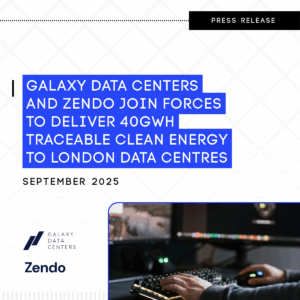
To achieve our goals, we partnered with UK energy tech innovator Zendo, who procured a £20m supply contract to deliver 40GWh of renewable energy annually, one of the lowest rates in the UK market that’s equivalent to the power demand of 15,000 UK homes. [See Press Release here]
Zendo’s ‘Energy OS’ software has enabled Redhill to navigate volatile energy markets and intermittent renewable sources such as wind and solar, while increasing capacity revenues and adapting to growing customer demands for high-density computing.
The provider is UrbanChain, a UK-based renewable energy trading platform that ensures direct traceability to the origin of renewable sources, rather than unlinked certificates. The contract provides a “variance level” on pricing, which allows Galaxy to increase or decrease its load by 50% to 150% without significant price penalties – variation allowances are typically 80% to 120%.
This flexibility is huge, helping our existing tenants pursue their sustainability goals, while saving them close to 30% on what they were paying for the previous owner’s hedged prices. Those savings will be available from day one for new tenants.
Technological readiness for high-density computing
Our framework commitment to future proofing facilities is about ensuring they can handle the surge in demand for high-density computing. Redhill is already there with customers deploying AI modelling workloads, utilizing 22kW racks, and running the latest NVIDIA GPUs.
Making this possible are high-density rack capabilities and a hybrid cooling solution – two-thirds air-cooled, one-third liquid-cooled – that handles the intense thermal loads of AI hardware. Moreover, Galaxy is implementing AI-driven predictive energy optimization. Set to go live in 2026, the software tool will further enhance efficiency, using AI to forecast and manage energy usage dynamically.
We are also planning the redevelopment of Units One and Two on the Redhill campus to be even more AI-focused. These projects are designed to attract customers interested in pre-leasing space for advanced workloads, leveraging surplus power and leading-edge infrastructure.

Leading by example in data center development
Part of Galaxy’s wider remit is to reduce the energy footprint of older, less efficient data centers, while retrofitting them for the demands of high-density computing. In Europe, where new power capacity is limited, repurposing existing infrastructure with advanced cooling (like direct liquid cooling and chilled water loops) is going to be very important.
Essentially, we are using Redhill as a blueprint for tackling the biggest challenges in the industry, demonstrating how clients can achieve a return on their data center investments without compromising on sustainability goals or regulatory compliance. At the same time, we will be optimizing the environment – as much as anybody can – for future innovations that are still to reveal themselves. Procuring renewable energy at a highly competitive rate is the icing on the cake.
We believe that Galaxy is setting new standards for efficiency, sustainability, and technological leadership. By combining direct renewable energy sourcing, innovative contract structures, and a commitment to AI readiness, we like to think we are charting a path for the industry as a whole to follow.