Last year started with analysts confirming that forecasts of “hundreds of billions” of investments in the data center sector were materializing. A massive wave of capacity demand, land deals and multi-gigawatt campus builds came to fruition, backed by huge equity financing rounds.
At the same time, site selection became a new priority — where design and contracts are written around GPU availability and rack power density, rather than just floor space.
With our January 2025 acquisition of the Redhill Data Centre in Greater London, Galaxy was part of the wave. We instantly made a mark by proving that sustainability and high-density compute capacity could be delivered concurrently — a signpost for the wider market, where capacity issues and power constraints continued to cause problems.
Another global trend saw hyperscalers pairing new builds with dedicated renewable energy resources, something we were already pioneering at Redhill. Our groundbreaking Power Purchase Agreement (PPA) secured 40 GW of renewable energy annually at one of the lowest rates in the UK market, while providing direct traceability to the renewable source. This innovation helped existing Redhill clients cut energy costs by around 30%.
Furthermore, the PPA’s flexible variance level (allowing Galaxy to adjust loads by 50-150%) helped the facility navigate volatile energy markets and intermittent renewable sources, directly addressing the need for operators to hedge grid risk and carbon exposure.
Rising to the AI challenge
Microsoft’s announcement in January 2025 of an $80 billion investment in AI-enabled data centers set the tone for one of the hottest topics of the year: how the sector was going to rise to the challenge of hosting high-density computing. Around the world, several countries started to secure large GPU inventories and national compute capacity to support sovereign AI projects.
Galaxy was already preparing for the challenge. Changes were made to Redhill to better equip it for the AI era — technical improvements that will be rolled out across our other facilities. Every key infrastructure requirement is met:
- Advanced liquid cooling: With direct-to-chip and immersion-ready infrastructure, Redhill is designed to provide the specialized environment that high-density AI clusters need. Units 1 and 2 at the facility now support 50-125 kW per rack.
- Real-time monitoring and operational certainty:Advanced monitoring and control systems provide Redhill customers with live data on power, cooling and environmental metrics. This data-driven approach ensures continuous verification of capacity, cooling and uptime, fostering a transparent, customer-centric relationship with our clients.
- Dual strategy of AI and colocation:Redhill supports cutting-edge AI workloads and traditional enterprise colo on the same campus. Units 1 and 2 are designed for hyperscale AI/GPU clusters, while Unit 3 offers six independent data halls for conventional IT and private cloud infrastructure.
Best of both worlds strategy
In the second half of 2024, 88% of cloud buyers told the IDC Cloud Pulse survey that they were deploying a hybrid cloud strategy or were in the process of operating one. Around the same time, IDC noted that prices, performance, security and compliance were considered growing constraints of public clouds. That’s not to say organizations are turning their backs on public clouds — uptake is still growing, in fact — they just want the best of both worlds.
No one is going all the way back to on-prem, but organizations are shifting some workloads to colocation and private cloud stacks. Cost control and increased regulations around data residency are driving the trend. The result is that hybrid strategies are expected to double by 2026, with 66% of European firms agreeing that a hybrid model is necessary for a successful business, according to Frost & Sullivan.
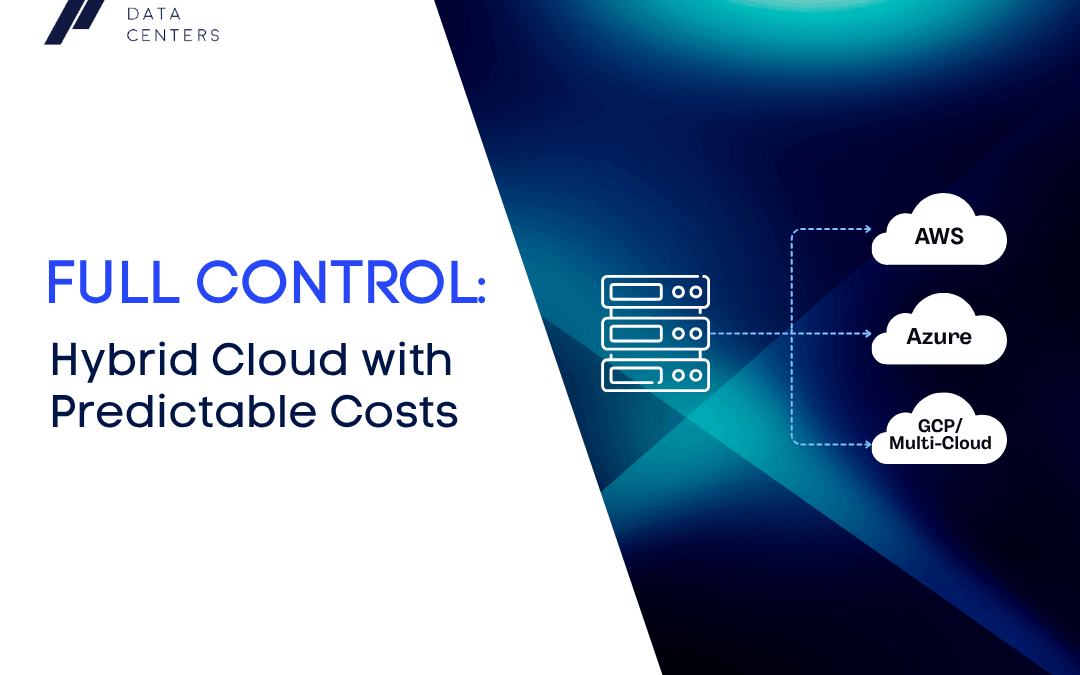
Galaxy directly addressed the strategy by offering cloud adjacent colo, a hybrid model where you can access public cloud benefits while retaining full control over core data and infrastructure. Our data center model provides fast access to public clouds with direct cloud on-ramps like AWS Direct Connect, Microsoft ExpressRoute and Google Cloud Interconnect.
Into the future
Industry reporting by Uptime Institute showed outages were declining in 2025, but power supply, cost pressures and operational complexity remained top risks. Data center operators are expected to compete on speed-to-market while ramping up their sustainability credentials and AI-hosting capabilities.
The Redhill acquisition was Galaxy’s blueprint for aggressive, sustainable growth: a strategy for tackling market complexity and embracing an AI-driven future without compromising compliance.
Part of Galaxy’s mission is to reduce the energy footprint of older, less efficient data centers, while retrofitting them for the demands of high-density computing. Given Europe’s power constraints, retrofitting existing infrastructure with advanced cooling is essential for future growth.
We believe that Galaxy is setting new standards for efficiency, sustainability and technological leadership that will become even more prescient in 2026. By combining direct renewable energy sourcing, innovative contract structures and a commitment to AI readiness, we’re committed to developing best-practice models at a time of enormous change.
By Dave Misra
Co-Founder and Managing Partner, Galaxy Data Centers | Data Center Strategist